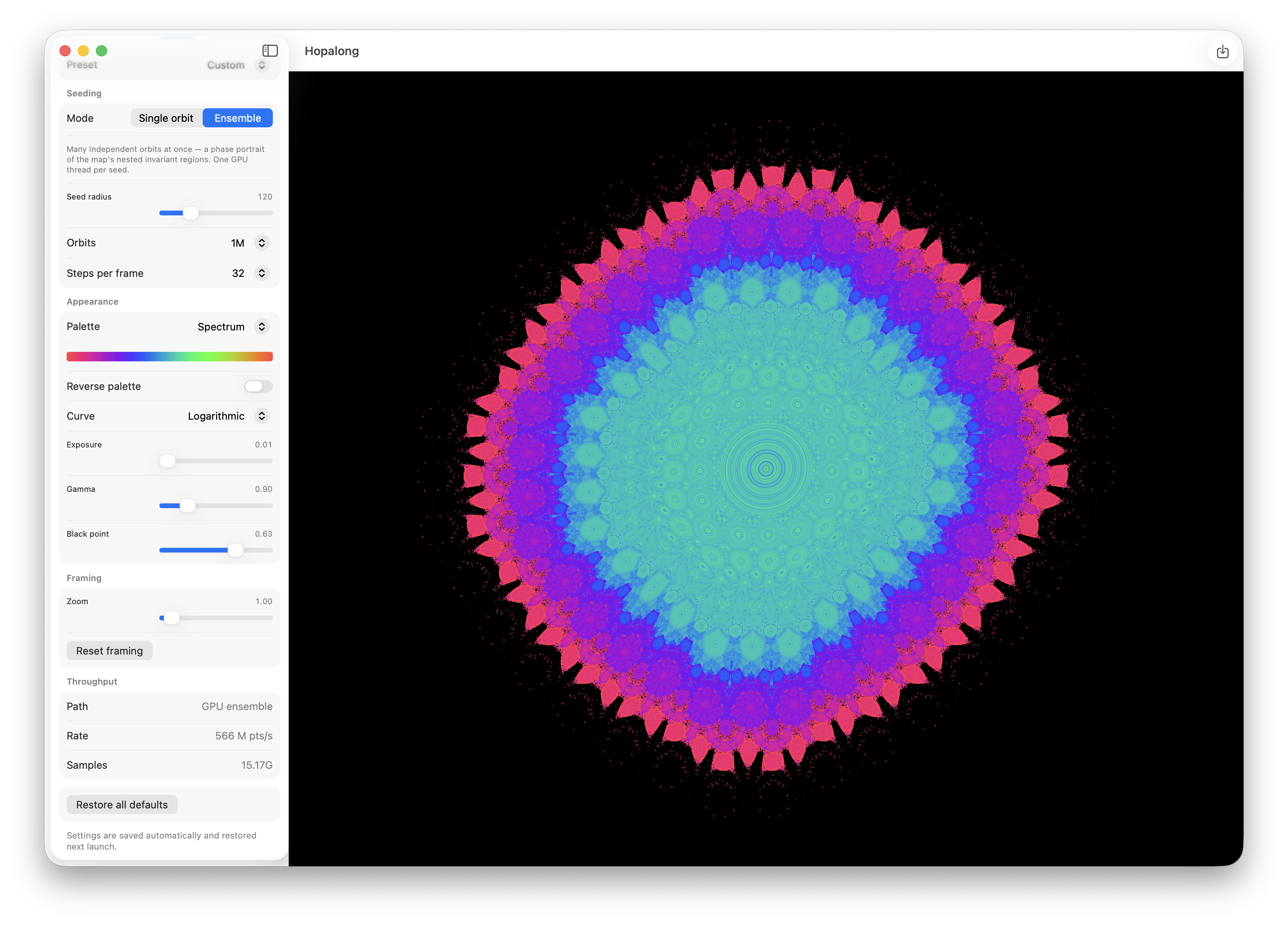
Hopping along, dots making fractals, but 40 years later
Draft of 2026.07.31
May include: mathematical recreations ↘ visualization ↗ AI ↖ programming ↙ &c.
In the late summer of 1986 I’d just finished up my undergraduate degree, and (if I recall the sequence of events at all these days) I spent some of those months working a summer job for the chairman of my department doing data entry for a biometrics project. There was a “fancy” IBM PC-AT, and as long as I transcribed the morbidity and mortality statistics into the correct Lotus 1-2-3 spreadsheets, I could also spend some time writing BASIC programs to explore the sort of bullshit that ended up being the throughline of my work. Which is to say, bullshit about “computer recreations”, fractals and chaos, biologically-inspired computing, artificial life, all that jazz. My Dad always had a Scientific American subscription, and Martin Gardner and Douglas Hofstadter and A. K. Dewdney columns were always things I looked at first thing.
Anyway, I do remember trying to write what little code I was able to manage. There were cellular automata, and definitely some fractals. Definitely the “Hopalong fractal” was one I vividly recall poking at. Who knows when it was exactly, except for being somewhere very close to 40 years ago.
This came back to mind the other day. I’ve been experimenting with Anthropic’s Claude Opus 5 model for coding, and also thinking back to unfinished explorations from the last… well, 40 years or so. So on a whim I started a clean, empty XCode Swift project, and proposed a simple prompt for the Invisible Antagonist to work on while I watched. I really did as little as possible, aside from reminding it to write the tests (part of the basic agents.md I use these days). I admit I was impressed with the results. I’m still looking through the codebase, but while I understand most of what happened, I’m sure that the entire system that fell out of the process is two or three paces beyond my capacity—not just in terms of coding knowledge, but also the UI and UX designs are… informative to one such as me.
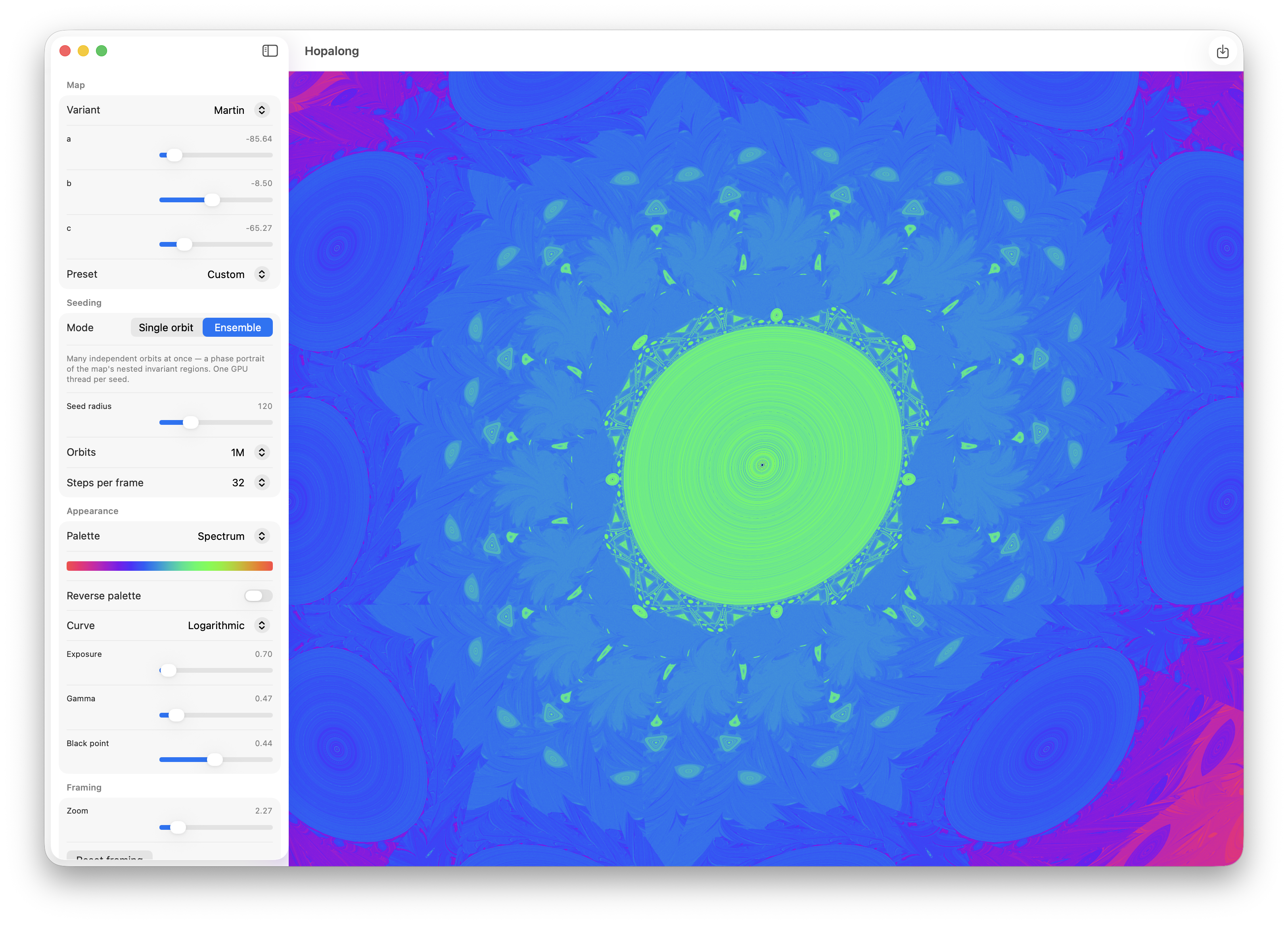
There were a couple of small things. The “custom palette” selection didn’t work at first. There wasn’t really a way to save an image. There was zooming on the image but no panning. Maybe zooming and panning could be a drag-gesture in the image being generated?
Not even additional prompts so much just nudges from me.
When it was as “done” as I could define, I told the IA to explain itself in a README.md, and cite its sources, and make sure an MIT license was in order, and to be as legible as it could in the process.
The resulting codebase is here in my GitHub repositories. It runs on my machine, and our other M3 MacOS desktop. I don’t know if it will compile on a non-metal Mac, because I find I no longer have one. Might need XCode 26 to compile?
I honestly don’t quite know what to make of the experience. Watching things unfold, and just looking into the comments and claims the IA made along the path, I can say I first learned things looking into its claims—things that I had been taught back in the 1990s, about nonlinear dynamics and the mathematics of attractors. I am also learning something about Metal coding (that it’s much more complicated and idiomatically weird than I will ever really be able to handle by myself).
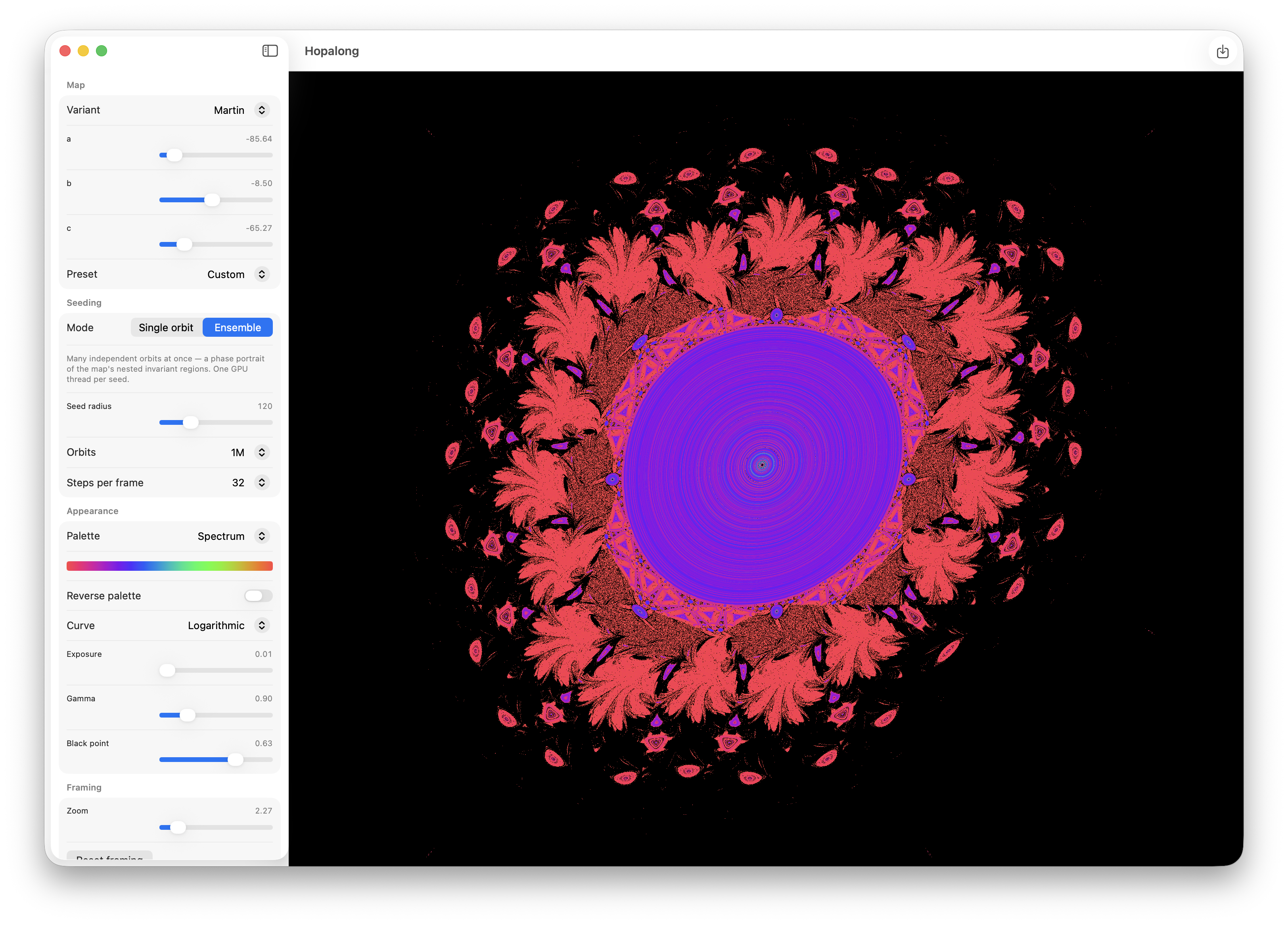
But also I feel I learned an object lesson about living across several cycles of Moore’s Law and related expansionary periods. The things I would have written on the IBM PC or Apple ][ or whatever, the “Hopalong fractal” that I tried to make? It would have been a single orbit, a single thread of points picked out on a virtual plane, maybe with colors but probably not. I’d guess it was the sort of thing you had to launch, watch a few seconds to make sure at least some of the points were inside the drawing frame, and then walked away for 20 minutes while pixels got a little tiny bit brighter. Guess and say maybe 100 pixels a second lighting up.
This thing I’m typing on, this laptop for coding and blogging and surfing? It produced graphics coloring 10+ billion pixels per second. I hereby attest that I had no clear idea of that. Like a frog in a pot, all that time the potential has been here, just sitting more or less unused on my lap, except to watch occasional videos of cats.
Something about the code I wrote before, with proficient partners and amateur helpers, seems to have changed while I ignored an outer context. Like we all missed something, as we tried to get things right by postponing getting them fast. That trade-off is nothing like “gone”. But the scales have shifted, and thoroughly.